


Making Space at the Table. What a Therapy Seminar Taught Me About Accessibility
Updated: Oct 8

One of the privileges of volunteering with Actcessible is that learning never really stops. We may use that phrase rather casually, but stepping into an unfamiliar world quickly reminds us how much we still have to learn.
Although my own professional background is in accountancy (don’t switch off; I’m retired now!), I have always believed that some of the most valuable lessons come from stepping outside our own area of expertise.
On 20th July I attended a three hour Continuing Professional Development (CPD) event entitled Making Space at the Table, Working Therapeutically with Disability, led by Louise Brookes MBACP (contact details at end of article), an integrative psychotherapeutic counsellor specialising in disability, neurodiversity and chronic illness.
The seminar was aimed primarily at therapists, so I expected to learn something about counselling. Instead, I came away reflecting on theatre, education, volunteering, safeguarding, communication and, perhaps most importantly, what genuine accessibility really means.
This article isn't a review of Louise's seminar. Nor is it an attempt to explain therapeutic practice. It is simply my personal reflection on some of the ideas that resonated most strongly with me, and how I believe they apply to the work we do at Actcessible.
Accessibility begins before anyone arrives
One of the first things Louise did wasn't to begin teaching. She began by asking participants about their access requirements.
Did anyone need additional breaks? Was the lighting comfortable? Was the pace suitable? Were there any adjustments that would help people participate fully?
It sounds so simple, yet it immediately set the tone. These questions came before the familiar opening invitation: “Tell us your name and something about yourself.”
Before asking people to introduce themselves, Louise first asked what they needed in order to participate.

Accessibility wasn't treated as something to think about later if someone encountered difficulties. It was considered before the learning had even begun.
Throughout the morning, we explored issues such as lighting, colour contrast, fonts, digital accessibility, sensory needs, fatigue, physical access and communication preferences. I found myself thinking that every one of these discussions applied just as much to Actcessible's workshops, performances, rehearsals, meetings and volunteer training as they did to counselling.
Accessibility isn't something we bolt onto what we already do. It should influence the way we design everything from the outset.
Learning from lived experience
What made the seminar particularly powerful was not simply Louise's professional expertise. It was the way she combined that expertise with her own lived experience of disability.
There is a profound difference between learning about disability and learning from someone who experiences disability every day.
That perspective became even more powerful through a moving presentation by Jodie, who spoke openly about years of navigating healthcare and mental health services that often expected her to adapt to inaccessible systems, rather than adapting to her needs. She also described the enormous difference made when she finally encountered a therapist who understood disability informed practice.
As I listened, I realised that lived experience isn't simply another source of information. It is expertise in its own right.
Policies, qualifications and research all matter enormously, but they become far richer when informed by the voices of people who have actually lived those experiences.
Questions that have no simple answers
Louise introduced several challenging questions and then allowed the discussion to develop openly among those attending. Some of those conversations have stayed with me ever since. One, in particular, has continued to occupy my thoughts.
“If a disabled client is physically unable to wipe away their own tears... should the therapist do it?”
It had never even crossed my mind that this was a question. How naïve was I? It was one of those moments when a light suddenly comes on and you begin seeing familiar things differently.
At first glance, it appears to have an obvious answer. But with the light on, it became clear that it doesn't.
The discussion explored safeguarding, professional boundaries, consent, dignity, dependence, autonomy and the therapeutic relationship itself.
Similar questions followed: How is the relationship affected if a carer has to remain in the room? What happens if medication has to be administered during a therapy session? Should professional boundaries ever change if someone is experiencing a mental health crisis outside their appointment?
There were no easy answers. Nor should there have been. The purpose wasn't to produce a checklist of rules. It was to encourage thoughtful, person centred reflection.
As I listened, I realised these are not simply questions for therapists.
Anyone working with people (teachers, volunteers, workshop leaders, performers or support workers) faces similar moments where kindness, dignity, safeguarding and autonomy all intersect.
Three words
During the discussion about wiping away someone's tears, three words came into my mind.
I typed them into the seminar chat.
Protection. Respect. Benefit.
Louise later commented that she particularly liked this way of approaching the dilemma, which I took as a genuine compliment.
The more I have reflected on those three words, the more useful they seem.
Protection Does this action protect both the individual and the professional relationship? Does it maintain appropriate boundaries while ensuring everyone remains safe? Is it a shared decision?
Respect Is my decision respectful? Does it preserve dignity, autonomy and the wishes of the individual? Am I acting with someone rather than simply doing something to them?
Benefit Who genuinely benefits from my action or from choosing not to act? Am I responding because it helps the other person, or because it relieves my own discomfort? How might my decision strengthen or unintentionally weaken the relationship of trust?
These questions will not always produce one universally correct answer. But perhaps that is precisely the point.
They encourage us to pause, think and place the individual, not ourselves, at the centre of the decision.
Language matters
Another discussion that particularly resonated with me concerned language.
It is easy to assume that there is one "correct" way to describe disability. The seminar reminded us that reality is much more personal than that. Some people proudly describe themselves as disabled. Others prefer the word impairment.
Some dislike that term because they feel it focuses on what they cannot do.
Others identify primarily as Deaf, autistic or neurodivergent. Some reject labels altogether.
Others simply do not see themselves as having a condition that defines them.
The important lesson wasn’t about choosing the “right” terminology. It was recognising that the right language is the language chosen by the individual.
That can be especially important when working with children.
Families often develop their own language.
A child might affectionately talk about “my funny leg.”
Another family may describe autism as 'your superpower', while another may dislike that expression entirely.
None of these expressions are inherently right or wrong. What matters is that they belong to the person. Rather than worrying about saying the perfect thing, perhaps we should simply ask:
“How would you like me to talk about this?” Or: “What do you call it at home?”
Listening before speaking may be one of the greatest acts of respect we can show.
Accessibility is personal
One of the strongest messages I took away from the session was that accessibility can never be reduced to a checklist. Two people with exactly the same diagnosis may need completely different adjustments. Some people welcome practical assistance. Others value independence above everything else. Some disabilities are immediately visible. Many are not. Some conditions remain constant. Others fluctuate from day to day.
Accessibility is therefore not about treating everybody the same. It is about understanding the individual. That philosophy lies at the heart of Actcessible.
We often talk about removing barriers. Perhaps the greatest barrier of all is assuming that everyone experiences the world in the same way, or always the same way.
What this means for Actcessible
Throughout the seminar I found myself translating every discussion into our own work.
How welcoming are our workshops? Do our rehearsal spaces work for everyone? Can everyone access our digital resources? Do our volunteers understand that disability is not always visible? Do we instinctively ask what adjustments might help someone participate? Do we listen before we assume?
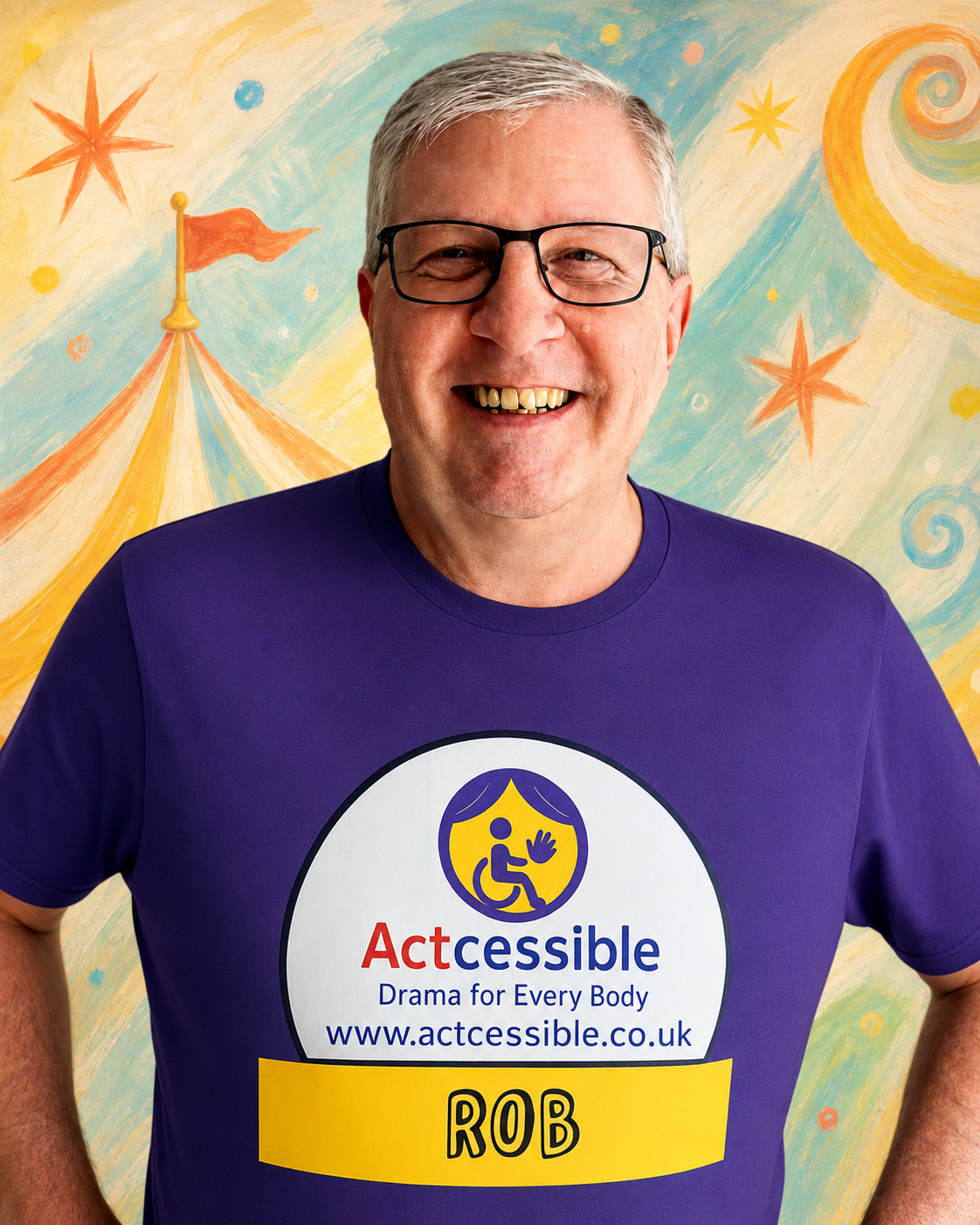
I appreciate better now why the frontline team of Actcessible are always asking themselves these questions and why planning is always a huge part of their creative process. For me, Back Office Bob, this had been something I only thought I understood.
Continuing to learn
It became obvious to me that these are not simply questions for therapists. They are questions for every organisation that wants to be genuinely inclusive.
Accessibility is often associated with ramps, lifts and legislation. Those things matter enormously.
But this seminar reminded me that accessibility is equally about attitude.
It is about curiosity. It is about listening. It is about recognising that lived experience is a form of expertise. It is about understanding that language matters. It is about asking rather than assuming.
And perhaps most importantly, it is about accepting that none of us ever stop learning.
As Actcessible continues its journey, I hope we never lose that willingness to question ourselves, to reflect on our practice and to learn from the lived experiences of others.
My thanks
I would like to express my sincere thanks to Louise Brookes MBACP for delivering such a thoughtful and inspiring seminar, and for so generously sharing both her professional expertise and her lived experience (contact details at end of article). My thanks also go to Jodie, whose honest and moving lived experience presentation illustrated so powerfully why disability informed practice matters.
I joined the seminar expecting to learn about therapy.
I left thinking about people. About listening before speaking. About seeing the person before the label, diagnosis or assumption. About designing environments that include rather than exclude. And about recognising that accessibility isn't something we achieve once and then tick off a list.
It is a continual process of learning, listening and improving.
Perhaps that is what making space at the table really means: not simply inviting people to sit down, but asking whether the table, the room and the conversation have been designed so that everyone can genuinely take part.
If there is one lesson I will carry forward from Louise's seminar, it is this: accessibility isn't about having all the answers. It begins by asking better questions, and then taking the time to listen to the answers.
Thanks again to: Louise Brookes (MBACP).
Instagram: @louiseb.therapy Email: psychotherapylb@gmail.com


Comments